
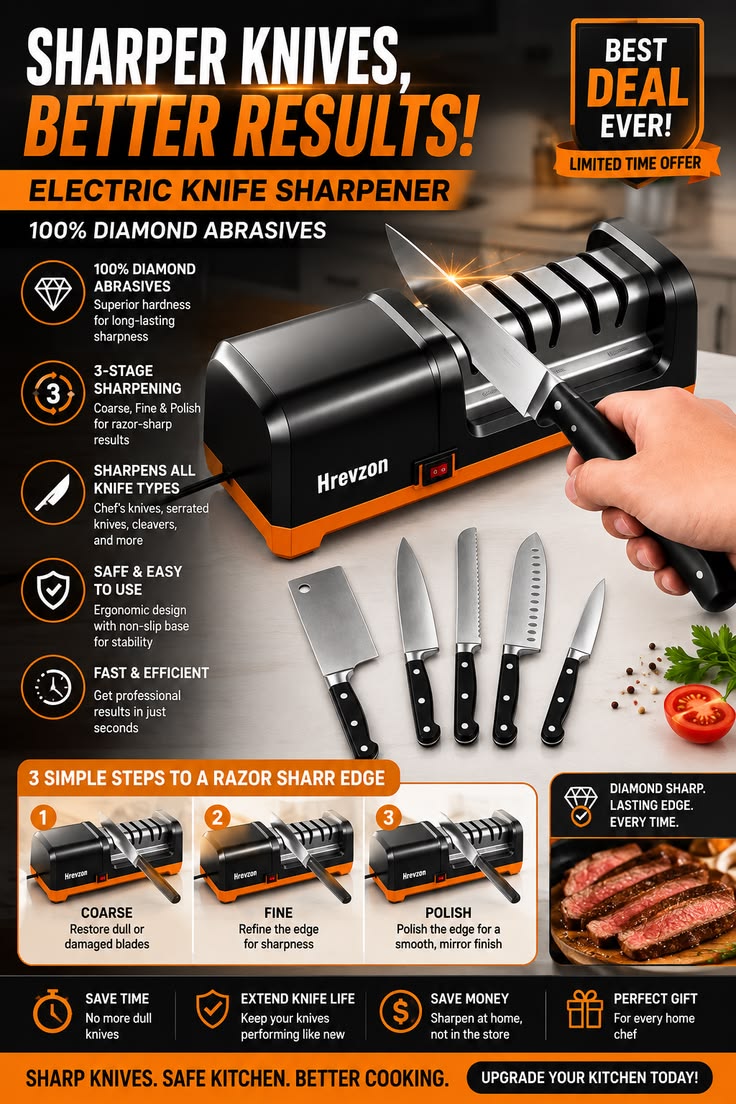
🔪⚡ Electric Knife Sharpener – 3-Stage Diamond Abrasive Sharpening System
Give dull kitchen knives a fresh edge with an electric sharpening system designed to simplify sharpening, honing and polishing through a convenient multi-stage process.
A convenient sharpening solution for maintaining everyday kitchen knives.
The 3-stage electric design is intended to handle different steps of blade maintenance, while diamond abrasives and guided sharpening slots can make the process more consistent than freehand sharpening.
View Product🔪 Overview
A sharp kitchen knife is an important part of comfortable and efficient food preparation. Over time, repeated cutting can gradually dull a blade, making everyday tasks feel more difficult.
This Electric Knife Sharpener is designed to simplify blade maintenance by combining multiple sharpening stages into one countertop appliance. Similar 3-stage diamond electric sharpeners typically use separate stages for repairing or reshaping a dull edge, refining it and polishing the finished edge. :contentReference[oaicite:0]{index=0}
For home cooks who prefer not to learn traditional whetstone techniques, an electric guided sharpener can provide a simpler and more repeatable approach to routine knife maintenance.
Exact sharpening angles, compatible blade types, motor specifications and included features can vary between electric knife sharpener models. Always check the current Amazon listing and manufacturer’s instructions for the exact product before use.
⚙️ How the 3-Stage System Works
The main attraction of a 3-stage sharpener is that different stages can perform different jobs instead of relying on a single abrasive surface.
- Stage 1 – Repair / Coarse Sharpening: Designed to address significantly dull or damaged edges by removing material and establishing a fresh bevel.
- Stage 2 – Fine Sharpening: Refines the newly formed edge and improves cutting performance.
- Stage 3 – Honing / Polishing: Refines and smooths the edge after the primary sharpening process.
Three-stage systems are commonly designed around this progression from edge repair to sharpening and final refinement. :contentReference[oaicite:1]{index=1}
The exact procedure should always follow the instructions supplied with your particular model.
💎 Diamond Abrasive Sharpening
Diamond abrasives are one of the key technologies used in professional and consumer electric knife sharpeners. Diamond is extremely hard, allowing abrasive surfaces to efficiently work against many common knife steels.
Several 3-stage electric systems use diamond abrasive wheels in the initial sharpening stages, followed by a dedicated polishing or stropping stage. :contentReference[oaicite:2]{index=2}
- Efficient material removal: useful for restoring dull edges.
- Durable abrasive surface: diamond abrasives are designed for repeated sharpening work.
- Consistent sharpening: guided slots help position the blade during use.
- Multi-stage refinement: different abrasive stages can progressively improve the edge.
📐 Precision Angle Guidance
Maintaining a consistent sharpening angle is important because repeatedly changing the angle can produce an uneven edge.
Electric sharpeners commonly use built-in guides to help keep the blade positioned at the intended angle. Depending on the model, this may be a fixed angle such as 20 degrees or a system capable of supporting different knife geometries. :contentReference[oaicite:3]{index=3}
- Helps reduce guesswork during sharpening.
- Provides a repeatable blade position.
- Useful for beginners who are unfamiliar with whetstone sharpening.
- Can help maintain a consistent bevel when used correctly.
Do not assume that every electric sharpener supports every angle. Verify the exact angle specifications for the model you purchase.
⚡ Easy Electric Operation
One of the biggest advantages of an electric sharpener is convenience. Instead of manually moving a blade across a sharpening stone or pull-through abrasive, the motorized system handles the abrasive movement.
This can make routine sharpening more approachable for people who want to maintain kitchen knives without spending significant time learning manual sharpening techniques.
- Motorized sharpening reduces manual effort.
- Guided slots simplify blade positioning.
- Multiple stages provide a structured sharpening process.
- Countertop operation makes the appliance convenient for home kitchens.
- Useful for periodic knife maintenance.
🍴 Knife Compatibility
Compatibility is one of the most important things to check before using any electric knife sharpener. Many models are optimized for standard straight-edge kitchen knives, while some advanced sharpeners also support serrated, single-bevel or specialty blades. :contentReference[oaicite:4]{index=4}
Common kitchen knives that may be supported by compatible models include:
- Chef knives
- Santoku knives
- Utility knives
- Paring knives
- Slicing knives
- Other standard straight-edge kitchen knives
However, do not automatically use the sharpener on serrated, ceramic or specialty blades unless the product’s instructions specifically state that they are supported. Some 3-stage diamond models are intended primarily for straight-edge knives. :contentReference[oaicite:5]{index=5}
✨ Sharpening Performance
A good electric sharpener should make a visibly dull knife more functional without requiring complicated manual technique. The 3-stage process can help progress from edge repair through sharpening and final polishing.
Performance depends on several factors, including the original condition of the knife, the blade steel, the sharpening angle, the number of passes and the amount of pressure applied.
- Dull knives: may require the coarse stage before refinement.
- Moderately dull knives: may need fewer passes depending on their condition.
- Routine touch-ups: can often require less aggressive sharpening than a badly damaged edge.
- Final refinement: the polishing stage can help smooth the finished edge.
Avoid excessive pressure. Let the sharpening mechanism do the work and follow the manufacturer’s recommended number of passes.
🧼 Cleaning & Maintenance
Sharpening produces small metal particles, so keeping the appliance clean is an important part of routine maintenance. Some electric sharpeners include a dedicated collection area for metal filings. :contentReference[oaicite:6]{index=6}
- Switch the appliance off before cleaning.
- Unplug it before performing maintenance.
- Empty or clean the metal-shaving collection area when necessary.
- Remove loose filings according to the manufacturer’s instructions.
- Keep sharpening slots free from accumulated debris.
- Never pour water into the electrical appliance.
- Store the sharpener in a dry location.
⚠️ Important Safety Considerations
An electric knife sharpener combines a powered motor with abrasive components and a very sharp knife. Proper handling is therefore essential.
- Read the manufacturer’s instructions before first use.
- Keep fingers away from the knife edge during and immediately after sharpening.
- Do not touch or inspect a freshly sharpened edge with your finger.
- Keep the appliance stable on a suitable countertop.
- Do not use damaged knives unless the instructions specifically permit repair sharpening.
- Unplug the appliance before cleaning.
- Keep the appliance away from water and wet surfaces.
- Keep children away from the appliance and sharpening area.
- Never force the knife through the sharpening slot.
Safety instructions for electric sharpeners commonly emphasize keeping hands away from the blade edge and unplugging the appliance before cleaning or maintenance. :contentReference[oaicite:7]{index=7}
🛒 Buying Considerations
Before purchasing an electric knife sharpener, compare the exact specifications rather than choosing based only on the number of stages.
- Sharpening stages: confirm what each stage actually does.
- Abrasive material: check whether diamond abrasives are used and where.
- Sharpening angle: verify whether the unit uses a fixed or adjustable angle.
- Knife compatibility: make sure your knives are supported.
- Motor: review the motor specifications if provided.
- Stability: look for a secure countertop base.
- Cleaning: check whether filings can be easily collected and removed.
- Instructions: confirm that clear operating and safety instructions are provided.
Pros & Cons
✓ Pros
- Convenient electric sharpening system
- Three-stage sharpening process
- Diamond abrasive technology
- Guided sharpening can improve consistency
- Less manual effort than traditional sharpening stones
- Useful for routine kitchen knife maintenance
- Compact countertop-style format
- Can be easier for beginners than freehand sharpening
✕ Cons
- Not every model supports every type of knife
- Can remove more blade material than necessary if overused
- Requires access to a power outlet
- Motor noise may be noticeable during operation
- Sharp blades require careful handling after sharpening
- Exact angle and compatibility vary by model
- Not a replacement for professional sharpening in every situation
Product Details
| Product | Electric Knife Sharpener |
|---|---|
| System | 3-Stage Electric Sharpening System |
| Abrasive Type | Diamond Abrasive |
| Primary Purpose | Knife Sharpening, Edge Refinement and Polishing |
| Operation | Electric / Motorized |
| Angle | Verify Exact Angle on the Current Product Listing |
| Best For | Compatible Kitchen Knives, Particularly Straight-Edge Blades |
| Cleaning | Remove Metal Filings and Follow Manufacturer Instructions |
| Power | Electric — Verify Voltage and Plug Requirements Before Purchase |
| Marketplace | Amazon |
Exact motor power, sharpening angle, compatible blade types, dimensions and other specifications should be confirmed on the current Amazon listing for the specific model.
Frequently Asked Questions
What does a 3-stage knife sharpener do?
A typical three-stage system progresses from coarse edge repair or sharpening to finer sharpening and finally honing or polishing. The exact function of each stage depends on the specific model.
Are diamond abrasives good for sharpening knives?
Diamond abrasives are widely used in knife sharpeners because diamond is extremely hard and can efficiently work against many knife steels. Different models use diamond abrasives in different stages.
Can an electric sharpener sharpen every knife?
No. Compatibility varies. Many models are designed primarily for straight-edge kitchen knives, while some advanced systems support additional blade types. Always check the manufacturer’s instructions.
Can I sharpen a serrated knife with this type of sharpener?
Only if the specific model states that serrated knives are supported. Some 3-stage sharpeners are designed only for straight-edge blades.
How often should I sharpen my kitchen knives?
There is no single schedule for every knife. Sharpen when the blade noticeably loses cutting performance rather than repeatedly sharpening a blade that is already sharp. Frequent light maintenance can reduce the need for aggressive sharpening.
Can an electric sharpener damage a knife?
Improper use can remove excessive material or create an unsuitable edge. Using the correct stage, angle and number of passes according to the manufacturer’s instructions is important.
Is an electric knife sharpener good for beginners?
A guided electric system can be easier for beginners because the machine controls the abrasive movement and helps guide the blade angle. Users should still read the instructions carefully and practice safe handling.
🔪⚡ A Convenient Way to Maintain Sharp Kitchen Knives
The Electric Knife Sharpener – 3-Stage Diamond Abrasive Sharpening System is an appealing option for home cooks who want a simpler approach to knife maintenance.
Its strongest advantages are the three-stage sharpening process, diamond abrasive technology, guided blade positioning and motorized operation. Together, these features can make sharpening more approachable than traditional freehand methods.
It is especially worth considering if you regularly use kitchen knives and want a convenient countertop sharpening solution. Before buying or using it, verify the exact sharpening angle, supported blade types, electrical specifications and operating instructions for the specific Amazon model.
Check Product on Amazon